Displayed Imbalance Displayed imbalance compares visible bid depth and visible ask depth. A strong imbalance can pull other traders into the same direction, even when some of that visible depth is fake or temporary.
Balanced book
Local Market Simulator
A local interactive market sandbox inspired by your Canva notes on liquidity, order-book imbalance, spoofing, and flash-crash dynamics.
Hover the highlighted terms to see short explanations of the market concepts on the page.
The simulator runs locally in your browser. Use aggressive orders to move price, passive orders to deepen liquidity, spoofing to distort perceived imbalance, and the sell program to stress the market into a flash-crash regime.
Model note
The live equations are shown in the Model Inspector below.
This version uses a stochastic order-flow process with liquidity feedback and no anchor-price mean reversion.
Colored overlays connect your actions to the tape: green marks buy-side interventions, red marks sell-side interventions, and amber windows show active spoofing periods.
The overview chart keeps the full market path. Drag the highlighted window or use mouse wheel on the main chart to zoom into a specific time range.
Balanced book
Stable quoting
Flat
PnL: 0.00
This simplified lab follows the nonlinear equations from your slide. Adjust only the core parameters and watch how cancellation efficiency, fill probability, and market push change immediately.
Keep the sliders above for the core parameters, then build your own spoof formula by dragging bubbles. Click a formula card first, then drag or tap tokens below. The live preview is rendered in LaTeX before you run it.
Exponential: starts gently, then ramps up faster as the spoof order drifts closer to the touch.
Tip: click any bubble already inside a formula to remove it. This keeps the editor visual and avoids typing mistakes.
Decay equation
Closed-form fraction
Readout
Move the sliders to see how the nonlinear fraction changes cancellation efficiency and how much visible pressure is left for the market to react to.
Asks sit above the mid price. Bids sit below it. The closest rows to the middle trade first.
Equation
Equation
Equation
Equation
Equation
What each control changes
Story mode
Read this section like a short slide deck. It starts with a market that looks calm, follows why Navinder Singh Sarao appears in the story, then shows how a screen signal can grow into a market-wide fall.
The key message: a market can look steady on screen and still become fragile very quickly.
Cause chain
If you need one clean explanation, use this chain: a visible signal changes behavior, behavior changes real trading, real trading scares liquidity away, and then price moves much faster.
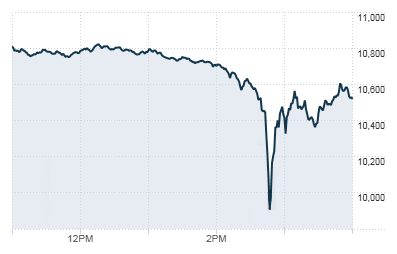
Price path
This chart is useful when you want to pause and ask students where the move stops looking like ordinary volatility and starts looking like a cascade.
Open Wikimedia chart source
Public story
This is useful when you want to shift from the market mechanism itself to how the case was later framed in public reporting.
Open Guardian reportComplexity
Sarao
Questions
Demo guide
Official source
Useful when you want the formal allegation language, including the description of layering, spoofing, and the claim that the conduct contributed to the Flash Crash.
Open DOJ press releaseOfficial source
Useful when you want the later legal outcome and a more concise summary of what the government said he admitted doing.
Open DOJ guilty plea releaseNews angle
Useful when you want a more reflective discussion: not only what one trader did, but also why the market was so vulnerable to rapid feedback loops.
Open New Yorker discussionLater perspective
Useful if you want to show students that the story did not end with the crash itself. It also helps frame how the event kept being reinterpreted years later.
Open Bloomberg article